


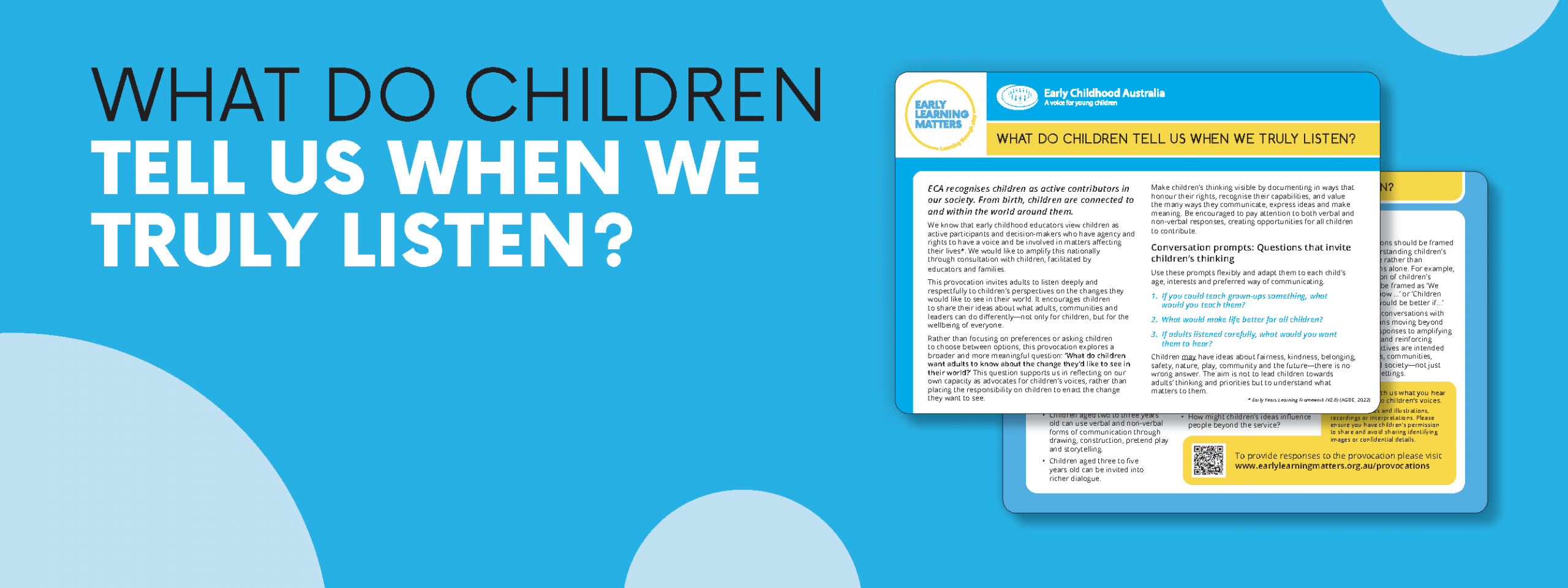
Provocation Card
This Early Learning Matters Week, ECA is inviting educators to explore this question with the children in their care.
Children are active contributors in the world around them. They have ideas about fairness, kindness, safety, belonging, nature and the future and those ideas deserve to be heard beyond their early childhood settings.
We have developed a provocation card to support educators in having meaningful conversations with children about what they want adults, communities and leaders to know and what change they would like to see in their world. The aim is not to collect opinions, but to amplify children’s voices and share what they are telling us with families, communities and policymakers.
Get Started
1. Download the provocation card
Use the conversation prompts with children in your setting. Adapt them to each child’s age, interests and preferred way of communicating.
2. Capture and share children’s voices
Once you have documented children’s responses — through words, drawings, photos or questions — share them using one of the options below.
What Educators Told Us
Educators engaged with the provocation card across different age groups and shared how the prompts supported authentic listening and meaningful conversations with children.
“The resource prompted valuable reflection for educators. It shifted our thinking from looking for verbal ‘answers’ to recognising that children’s voices are expressed through relationships, behaviour, exploration, and emotion.”
How educators used the card when engaging with babies:
Rather than asking the questions directly, educators interpreted the provocation through observation and responsive interactions. By slowing down, following children’s lead, and being fully present, they noticed what mattered to babies through their gestures, facial expressions, movements, emotional responses, repeated interests, and interactions with others.
, "It shifted our thinking from looking for verbal 'answers'."
“One of the strengths of the resource was its flexibility throughout the day, rather than as a single planned experience. Educators were able to incorporate questions naturally during play, meals and routines, resulting in more genuine responses.”
How educators used the card:
The prompts encouraged meaningful discussions about relationships, play, belonging, safety and wellbeing. Educators used the questions throughout the day and extended conversations through follow-up questions and observations, recognising that even brief responses reflected what is developmentally appropriate for toddlers.
, "The best conversations happened naturally."“The questions worked best when they became part of authentic conversations rather than feeling like an interview. Children often moved fluidly between the question and what was currently important to them, and those seemingly unrelated stories frequently revealed the deeper thinking the provocation was seeking.”
How educators used the card:
Educators introduced the questions naturally during afternoon tea while children were eating, chatting with friends and educators, and sharing stories about their day. They found that children rarely answered the question in isolation. Their responses were intertwined with stories about family, birthdays, swimming lessons, friendships, favourite television shows, lunchboxes, and everyday experiences. These conversations demonstrated that children’s perspectives emerge most authentically when they feel relaxed, connected and unhurried.
, "Children's stories revealed what mattered most."